Thailand · New Zealand passport
Thailand visas for New Zealanders: prepare through the right mission.
New Zealanders planning a trip to Thailand must first verify their specific visa category, as the tourist exemption differs significantly from requirements for retirement, study, or remote work. The destination authority sets these entry rules based on nationality and purpose, meaning Wellington's official online instructions serve as the primary reference rather than third-party summaries or converted fee lists found elsewhere.
Applicants should prioritize using the verified checklist provided by the New Zealand mission to ensure all evidence aligns with current expectations. Relying on outdated information from other embassies or unverified sources can lead to rejected applications, so it is essential to confirm eligibility and document requirements directly through the official application portal before submitting.
- Confirm your specific visa category matches your travel purpose such as tourism or remote work.
- Access the official online application instructions from Wellington's website for accurate steps.
- Review the complete evidence list required by the destination authority for your nationality.
- Verify that all documents meet current standards before finalizing your submission.
New Zealanders should consult the official Thai embassy in Wellington or a nearby mission to confirm current visa requirements for Thailand. Entry rules are determined by the destination authority, and eligibility criteria may change, so it is important to review specific conditions such as passport validity and proof of onward travel.
Before applying, ensure all required documents align with those listed by the relevant consulate. Consider whether your travel plans involve activities that may require additional permits beyond standard visa requirements.
- Consult the official Thai embassy in Wellington or a nearby mission for current visa rules.
- Review specific eligibility criteria and document lists from the relevant consulate.
- Determine if any planned activities require extra permits beyond the main visa application.
- Confirm travel arrangements such as return tickets or onward journey proof.
Allow 30 days for an exempt tourist visit.
New Zealanders planning to visit Thailand after September 15, 2026, should check the latest visa rules directly with official sources. Entry conditions may vary, and it is important to understand how long a stay can be granted without a pre-arranged visa and whether extensions are possible upon arrival.
Visitors should prepare questions for immigration officials about their specific situation, including any potential need for an extension or additional documentation. It is essential to confirm the actual dates of entry or extension as determined by authorities at the time of arrival.
- Contact official Thai immigration sources to clarify current visa rules and stay duration for New Zealanders.
- Ask immigration officers upon arrival about options for extending your stay beyond the initial period.
- Inquire whether a visa is required in advance or if entry can be made without one.
- Confirm the exact dates of your entry or extension as officially recorded by immigration authorities.
Ensure your passport is valid for the duration of your stay and meets any entry requirements set by Thai authorities. Confirm you have a return or onward ticket, and be prepared to demonstrate sufficient funds for your trip. Submit the Thailand Digital Arrival Card within the required timeframe before arrival and keep confirmation with your travel documents. Understand that visa approval and arrival card submission are separate steps with different purposes.
Before finalizing plans, check directly with official sources to confirm passport validity rules, financial requirements, and arrival card submission timelines. Clarify whether a return ticket is mandatory or if alternative proof of onward travel is accepted. Ensure you know how to distinguish between visa status and arrival card obligations for smooth entry into Thailand.
- Confirm passport meets Thai entry requirements and remains valid for the full duration of your stay.
- Check with official sources to verify financial requirements and whether they must be demonstrated at border control.
- Submit the Thailand Digital Arrival Card within the required timeframe before arrival and retain confirmation.
- Clarify if a return ticket is required or if alternative proof of onward travel is acceptable.
Wellington uses Thai eVisa.
New Zealanders must verify Thailand's current entry rules before applying, as the embassy determines eligibility based on nationality and travel purpose. The official eVisa system requires creating an account and uploading specific documents like a valid passport and proof of onward travel. Applicants should confirm whether their situation allows for online submission or if physical couriering of originals is necessary, since routine mail-in processes are often excluded from digital workflows.
To ensure accuracy, compare the embassy's published instructions against your personal circumstances regarding residency and visa type. Ask yourself if you meet all criteria for the tourist eVisa versus a standard entry permit, noting that requirements can shift without notice. Review the payment gateway details carefully to avoid unauthorized charges, while checking for any special conditions affecting Cook Islands or Niue residents who may share similar application pathways.
- Confirm your specific nationality and residency status matches the embassy's accepted applicant list.
- Verify whether your travel purpose qualifies you for the online eVisa system or requires a different process.
- Check if original passport documents must be mailed separately from the digital application submission.
- Review the official payment instructions to ensure funds are transferred through the designated secure site.
Applicants should plan to submit their Thailand visa applications well in advance of travel. It is important to consider that processing times may vary, and additional documentation could be requested. This means allowing sufficient time for any necessary corrections or submissions.
Before applying, review the specific requirements set by the relevant mission to ensure all documents are complete. Consider how your travel dates might align with service availability and whether you have enough time to address any potential issues before departure.
- Review the mission's criteria to confirm that all required documents are prepared.
- Ensure travel plans allow for possible delays in processing or additional requests for information.
- Inquire directly with the relevant authority about current processing times and service availability.
- Keep extra copies of all supporting evidence for potential submission requests.
New Zealanders applying for a Thailand visa must verify Wellington's latest fee and DTV-document notices to ensure accuracy, as official guidance updates frequently without automatic conversion of older figures. Relying on outdated published data can lead to incorrect financial planning or missing required documentation, so always cross-reference the current online portal with any recent government alerts before submitting your application.
When comparing visa options, focus on eligibility criteria and document requirements rather than assuming costs remain static over time. Ask yourself whether your specific travel dates align with current processing windows and if you possess all necessary proof of funds or health declarations demanded by the destination authority today.
- Confirm the latest application fee displayed on Wellington's official portal matches your selected visa category.
- Review any recent DTV-document notices for changes in required supporting materials or submission formats.
- Verify that your nationality and travel dates do not trigger special entry rules or temporary restrictions.
- Prepare all documents listed in the current guide to avoid delays caused by missing or incorrect information.
Prepare the Wellington retirement evidence.
New Zealanders applying for the Non-O visa should confirm with official Thai immigration sources to understand the required financial documentation. This includes verifying whether two months of bank statements or an income certificate is acceptable, and what specific thresholds apply. Applicants are also advised to prepare a detailed itinerary and proof of accommodation that align with their intended stay.
Health insurance requirements must be confirmed directly with relevant providers to ensure coverage meets the minimum standards for outpatient and inpatient care during the period of residence. It is important to compare current documents against these criteria before submission.
- Contact Thai immigration authorities to confirm financial documentation requirements, including bank statements or income certificates.
- Check with official sources to determine acceptable thresholds for available funds or monthly earnings.
- Prepare a detailed itinerary and proof of accommodation that match the planned stay duration.
- Consult health insurance providers to verify coverage meets minimum outpatient and inpatient standards.
New Zealanders should check visa eligibility and document requirements for Thailand through official sources, as entry rules are determined by the destination authority. Retirement routes may involve specific procedures for initial entry and extensions, with different financial and documentation criteria. The Non-O-A category provides longer stays but requires its own set of documents. It is important to confirm whether New Zealand is included in any relevant visa lists or if alternative options apply.
Planning should include verifying eligibility for retirement visas, understanding the requirements for Non-O-A applications, and confirming document submission rules for both initial entry and extensions. Readers are advised to consult with official providers to ensure accurate information on available routes and procedures.
- Confirm whether New Zealand is included in any visa lists relevant to Thailand entry.
- Verify specific financial and documentation requirements for retirement visas and Non-O-A applications.
- Check eligibility for retirement pathways and alternative entry options if not qualified.
- Consult official providers to confirm current document submission rules for initial entry and extensions.
Before applying for the BOI Long-Term Resident program, you must verify that your specific income sources and investment holdings meet the strict thresholds set by Thai authorities. A New Zealand pension alone does not confirm eligibility, so carefully review the official requirements regarding annual earnings and asset values to ensure your profile aligns with the criteria.
You also need to confirm whether your current health coverage satisfies the mandatory insurance standards for long-term residents. Since these rules are determined by the destination country rather than your nationality, ask yourself if your existing policy provides sufficient protection within Thailand without gaps or exclusions that could disqualify you.
- Compare your total annual income against the minimum threshold required for the program.
- Verify that your investment portfolio meets the specific asset value criteria.
- Confirm your health insurance policy covers all mandatory benefits in Thailand.
- Check if your New Zealand pension satisfies the separate income requirements listed on the BOI website.
Wellington Non-O requirements · Thai mission: O-X nationality list · BOI LTR criteria
New Zealanders seeking the Wealthy Pensioner Long-Term Resident visa must verify specific eligibility criteria set by the Board of Investment. Applicants need to confirm whether they meet age requirements, such as being fifty or older, and understand how income thresholds interact with investment options. The process involves checking if your annual passive income reaches US$80,000 or if you qualify for the lower bracket combined with a substantial Thai investment.
Beyond financial metrics, you must assess mandatory health coverage or deposit conditions alongside the ten-year framework structure. This includes reviewing the initial five-year permission period and determining what further qualification checks are needed to extend your stay. Always consult official BOI resources to ensure your personal circumstances align with current regulations before submitting an application.
- Verify your age meets the minimum requirement of fifty years or older.
- Calculate if your annual passive income satisfies the US$80,000 threshold.
- Confirm eligibility for the lower income bracket plus a qualifying Thai investment.
- Review mandatory health coverage or deposit requirements before applying.
Choose DTV only for a qualifying purpose.
New Zealanders seeking the DTV visa must verify that their specific remote work or medical treatment purpose aligns with current Thai immigration guidelines before applying. While a financial threshold of THB500,000 is often cited as a central requirement, applicants should observe whether this figure applies universally or varies based on individual circumstances and supporting documentation provided during the review process.
The visa typically offers five-year multiple-entry validity allowing stays up to 180 days per entry, with potential extensions of another 180 days through Immigration authorities. Readers must decide if their travel plans require such flexibility and ask whether their specific activity qualifies for this extended period without needing a new application.
- Confirm your remote work or treatment purpose matches the DTV eligibility criteria.
- Gather proof of funds to demonstrate financial stability for your stay.
- Check if your planned activities qualify for the five-year multiple-entry validity.
- Verify whether your specific situation allows for a potential 180-day extension.
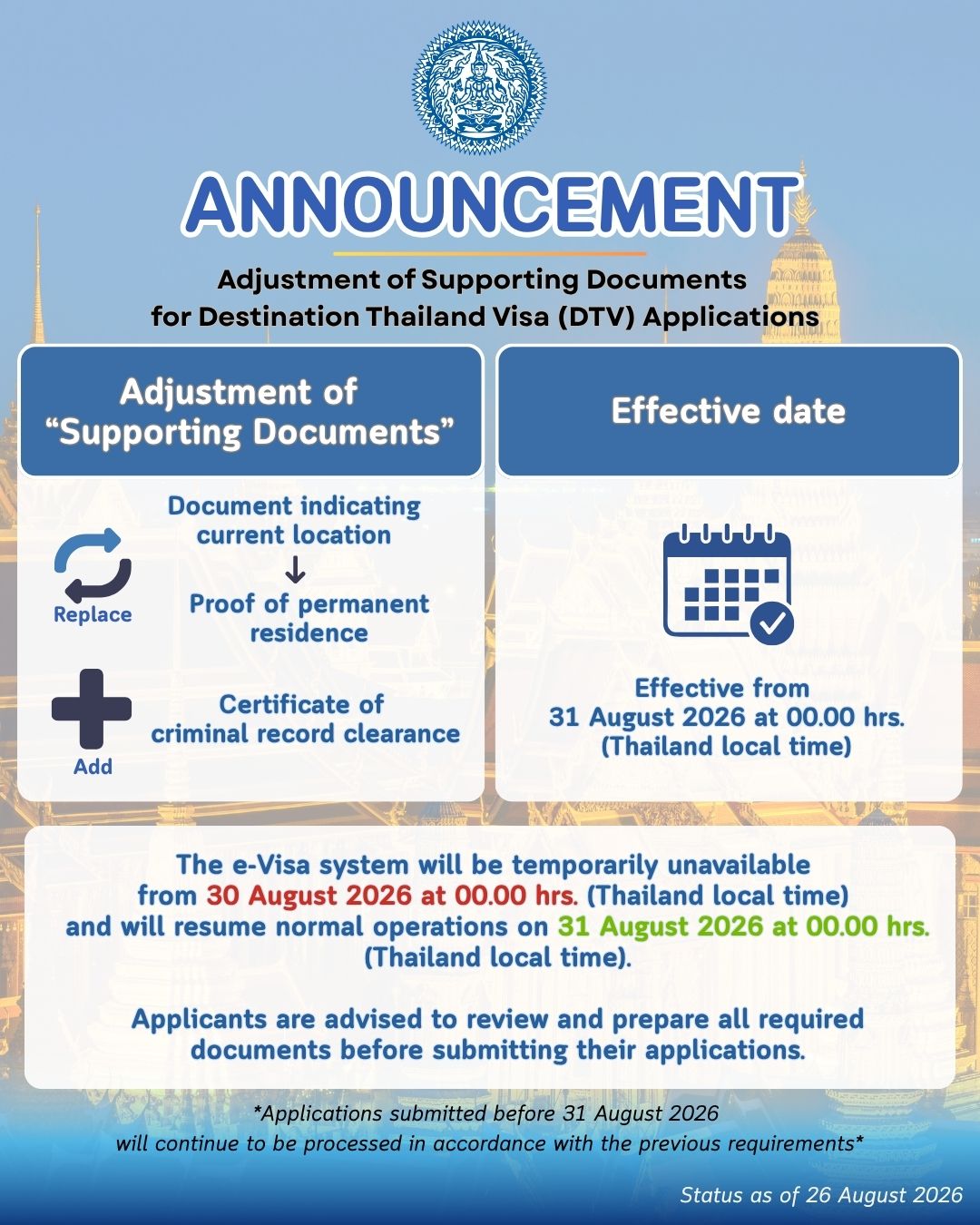
Check for document updates after August 31, 2026, and ensure all required forms are current. Confirm whether proof of permanent residence and criminal record clearance is needed, and from which authority these documents must be obtained. Verify the specific financial evidence required and how it should be presented. Ensure that any employment or education sponsorship meets the requirements set by the relevant institution or employer.
Confirm family relationships and determine if a sponsor is required, including what documentation they must provide. Ask the appropriate immigration authority to clarify all conditions for visa approval and submission procedures.
- Contact the immigration authority to confirm document update dates after August 31, 2026.
- Ask which official body issues proof of permanent residence and criminal record clearance certificates.
- Inquire with potential employers or educational institutions about sponsorship requirements.
- Request clarification from the immigration authority on financial evidence and family sponsor documentation.